


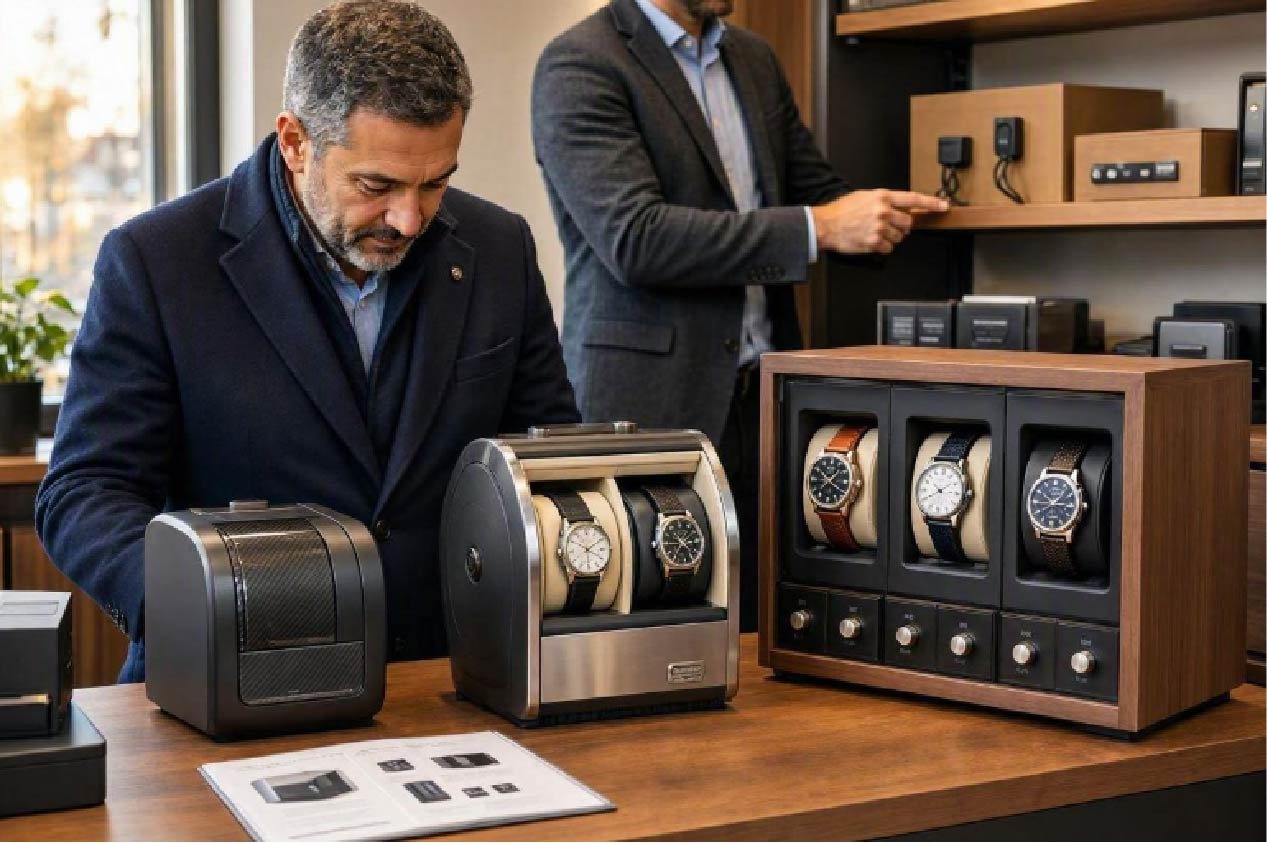
If you own an automatic watch, you already know the small frustration of picking it up after a few days and finding it dead. Automatic movements run on motion, not batteries, so once they stop, you have to reset the time, the date, and sometimes even more complicated functions. A watch winder solves that problem by keeping your watch moving when you’re not wearing it. But not every winder suits every watch, and buying the wrong one can do more harm than good.
This guide walks through exactly what to look for, how winders work, and how to match one to your collection, whether you own a single daily-wear piece or a growing rotation of automatics.
What a Watch Winder Actually Does
A watch winder is a small motorized box that gently rotates a watch on your wrist’s behalf. Inside an automatic movement sits a rotor, a weighted piece that swings with your natural arm motion and winds the mainspring. Take the watch off, and that rotor stops moving, so the spring gradually unwinds and the watch stops.
A winder mimics wrist motion by turning the watch case in a controlled pattern. This keeps the mainspring wound, keeps the lubricants inside the movement evenly distributed, and means you can pick the watch up ready to wear instead of resetting it every time.
Do You Actually Need One?
Not every automatic watch owner needs a winder, and it’s worth being honest about that before spending money. You’ll get real value from one if:
- You own a watch with a perpetual calendar or annual calendar complication, where resetting the date is a genuine hassle
- You rotate between several automatic watches and don’t wear each one often enough to keep it wound
- You want your watch fully wound and accurate the moment you put it on
- You store watches for weeks at a time and want to protect the movement from staying still for long periods
If you wear the same automatic watch every day, you may never need a winder at all — your own wrist does the job. For a deeper look at when a winder genuinely helps and when it’s unnecessary, this breakdown of the pros and cons of using a watch winder is worth reading before you buy.
Key Factors to Consider Before Buying
1. Turns Per Day (TPD)
Every automatic movement has a manufacturer-recommended number of rotations needed to stay fully wound. This is called turns per day, or TPD, and it varies significantly between brands and calibers. A Rolex movement, for example, typically needs somewhere between 650 and 950 TPD, while many Seiko and Omega movements sit lower.
Winding a watch at the wrong TPD causes real problems. Too few turns and the watch won’t stay wound. Too many turns can put unnecessary strain on the mainspring and rotor over time. Before buying a winder, check your watch’s specific TPD requirement, usually available from the manufacturer or in the watch’s manual.
2. Rotation Direction
Movements are built to wind in one of three ways: clockwise only, counter-clockwise only, or bidirectionally. Fitting a unidirectional movement into a winder that only rotates the wrong way does nothing useful and can add unnecessary wear. A good winder lets you set the direction to match your watch, and higher-quality models offer independent direction control per slot if you’re winding more than one watch at a time.
3. Number of Slots
Single winders suit one automatic watch and work well for someone who owns just one or two pieces. If your collection is growing, a multi-slot winder lets you store and wind several watches at once, each with its own independent settings for TPD and direction. This matters because a one-size-fits-all setting across multiple watches from different brands rarely works well.
4. Motor Quality
This is where cheap winders fall short. A low-quality motor runs constantly, generates unnecessary vibration, and can be noisy enough to notice in a quiet room. Better winders use Japanese-made motors (Mabuchi motors are a common benchmark in the industry) that run intermittently in short cycles rather than continuously, which is both quieter and gentler on the watch.
5. Build and Interior Materials
The inside of the winder matters as much as the outside. Look for a soft microfiber or velvet lining that won’t scratch the case or bracelet, a secure watch cushion that holds the watch snugly without excessive pressure, and a lid that fully blocks dust and light. Wood and leather-finished exteriors tend to hold up better over years of daily use than basic plastic housings.
6. Power Options
Most winders run on both mains power and batteries, giving you flexibility if you want to display the winder somewhere without a nearby outlet. Battery-only models are convenient for portability but need regular battery changes, so check expected battery life before choosing one for long-term use.
Matching a Winder to Your Collection Size
One automatic watch: A single winder is all you need. Focus on getting the TPD and direction settings right rather than paying extra for features you won’t use.
Two to four watches worn in rotation: A multi-slot winder with independent settings per slot lets you store your collection safely and keep each watch ready to wear without resetting complications every time you switch.
A larger or growing collection: Multi-slot winders with programmable settings and higher-end motors are worth the investment, since they protect movements over the long term and save you the daily hassle of manual winding and resetting.
If you’re ready to compare options built specifically for different collection sizes and movement types, the Aevitas premium watch winders range covers single and multi-slot models with adjustable TPD and direction settings for major luxury brands.
Common Mistakes to Avoid
Buying based on looks alone. A winder is a piece of equipment your watch relies on daily. Prioritize motor quality and correct settings over finish, even though a nice finish is a welcome bonus.
Ignoring the manufacturer’s TPD recommendation. Guessing at a setting, or leaving a winder on a generic default, can either under-wind the watch or add unnecessary strain over months and years of use.
Overcrowding a multi-slot winder with mismatched settings. If your watches need different TPD or directions, don’t compromise with a single shared setting across all slots. Look for independent programming per slot instead.
Leaving a watch in a winder indefinitely without checking it. Even a good winder benefits from an occasional check to confirm the watch is still keeping accurate time and the movement isn’t showing any signs of strain.
Caring for Your Watch Winder
A winder is a long-term investment alongside your watches, so it’s worth maintaining properly. Keep it away from direct sunlight and humidity, which can damage both the watch and the winder’s interior lining. Dust the exterior regularly, and check the cushion and lining periodically for wear, especially if you swap watches in and out often. If the winder uses batteries, replace them before they run low rather than after the watch has already stopped.
For a broader technical explanation of how mainsprings and automatic movements work internally, the Horological Society of London publishes detailed educational resources that go deeper into watchmaking mechanics than most retail guides.
Final Thoughts
A watch winder isn’t a luxury extra — for the right collection, it’s a practical tool that saves time and protects your watches from the wear that comes with sitting still for long periods. The key is matching the winder to your specific watch or watches: correct TPD, correct rotation direction, and a build quality that won’t damage the case or movement over years of use.
Whether you’re buying your first winder for a single watch or building out storage for a growing collection, take the time to check your movement’s requirements before choosing a model. You can browse the full range and compare options directly on the Aevitas UK website, where every winder listing includes the settings needed for accurate winding.
FAQs
How many hours a day should a watch winder run? Most winders run in short cycles throughout the day rather than continuously, typically totalling a few minutes of actual rotation spread across several hours. This is enough to meet the TPD requirement without over-winding the movement.
Can a watch winder damage my watch? A well-made winder set to the correct TPD and direction won’t damage your watch. Damage risk comes from using a low-quality motor, setting the wrong direction for a unidirectional movement, or leaving a watch in cheap or ill-fitting cushioning for extended periods.
Do all automatic watches need the same TPD setting? No. TPD varies by brand and specific movement, sometimes significantly. Always check your watch’s manufacturer specifications rather than relying on a generic setting.
Is it worth buying a watch winder for just one watch? Yes, if that watch has a complication like a perpetual calendar that’s difficult to reset, or if you don’t wear it often enough to keep it naturally wound. If you wear it daily, a winder is optional rather than necessary.
How long can a watch safely stay in a winder? There’s no strict time limit as long as the winder is functioning correctly and set to the right TPD and direction. Many collectors keep watches in winders indefinitely between wears, checking periodically that timekeeping remains accurate.













Discussion about this post